
What do mold remediation companies do? Here's what we do at Summit Mold Remediation: we inspect the property, find the moisture source, contain the affected area, remove and treat anything contaminated, and confirm the space is safe before we call a job finished. We built our entire process around that last part, fixing the moisture instead of just the mold, because it's the difference between a job that lasts and one you'll be repeating in a year.
Our IICRC, NADCA, and NORMI certified team has run this process on jobs across the Triangle for more than 15 years. Below is exactly how we handle a mold remediation in Raleigh job from your first call to final clearance, including a recent large-scale project we completed in the area.
How We Draw the Line Between Removal and Remediation
We get asked a lot whether we "remove" mold or "remediate" it, so here's how we think about it. Removal is what we'd call cleaning up what's visible. Remediation, which is what we actually do on every job, means containing it, removing it, drying the space, and fixing whatever let the mold grow there in the first place.
We build every job around that second definition on purpose. If we only cleaned the visible spot and left the leak or humidity behind it untouched, we'd be back at your property in a few months treating the same thing. If you've noticed a musty smell in your bathroom but haven't spotted visible growth yet, this is usually why: we find that the moisture problem is already there even when the mold hasn't caught up to it yet.
How We Handle a Mold Remediation Job in Raleigh
We run every project through the same six stages, whether it's a single bathroom or a whole-house job.
1. We visit the property and inspect the affected areas. We typically respond to new inquiries within about 30 minutes during business hours, and we offer an inspection before we ever send a quote. On-site, we use moisture meters and infrared cameras to map exactly where the problem has spread, including the parts you can't see yet. This is the same process we run as our standalone mold inspection in Raleigh service.
2. We identify the moisture source. We treat mold as a symptom, not the actual problem, so we trace it back to the leak, humidity, or ventilation issue feeding it. We won't quote you a fix that only addresses the mold and skips this step.
3. We explain our findings and recommend a solution. Before we touch anything, we walk you through exactly what we found and what it will take to fix it, then hand you a written, itemized quote. Since pricing depends heavily on your specific property, we've laid out our typical ranges in our mold removal cost guide if you want a sense of what to expect before we come out.
4. We contain the area. Once you approve the plan, we seal off the workspace with plastic sheeting and negative-air containment, and we run HEPA-filtered air scrubbers throughout the job so spores stay out of the rest of your home or business.
5. We complete the remediation. We remove drywall, insulation, or wood that can't be salvaged, and we treat remaining surfaces with EPA-registered antimicrobial and antifungal solutions. We also fix the moisture source directly in this same step, sealing a leak, adding a vapor barrier, or improving ventilation. We typically wrap up a residential job in 2 to 5 days; we cover what changes that range in our full timeline breakdown.
6. We confirm the space is safe. We run a final inspection and, where applicable, post-remediation clearance testing, then we walk you through before-and-after documentation ourselves. We give you that record because it matters whether you're closing on a home sale or working through an insurance claim, and we've broken down what's typically covered in our guide to insurance and mold coverage.
We back every project with a guarantee on the work performed at the time of service. If you're enrolled in our annual maintenance plan, we also back it with a 3-year mold-recurrence warranty, so if mold returns to a properly maintained property, we re-clean the covered area at no charge.
A Recent Raleigh Project: Large-Scale Mold Remediation
We recently worked a property that needed remediation across several rooms and structural areas at once, not just a single spot. We started by removing the affected drywall and ceiling material to expose the full extent of the hidden contamination, since we've learned that surface mold on a job like this is rarely the whole story.
From there, we treated the remaining walls, framing, and other structural surfaces, scaling our containment and PPE protocols to the size of the job and addressing each affected area individually rather than treating the property as one uniform space. Once treatment was complete, we cleaned the property thoroughly and prepared it for the next stage of restoration work.
Jobs at this scale are exactly why we don't quote sight-unseen. We've seen a visible ceiling stain turn into a multi-room job once we opened things up, and we can only price it accurately after we've seen it ourselves.
What We Bring to Every Job
Here's the equipment we show up with, and why it matters more than what's available at a hardware store.
- We use moisture meters and infrared cameras to find dampness you can't see
- We set up negative-air machines and HEPA scrubbers for containment and filtration
- We run industrial-grade dehumidifiers that pull far more moisture than a household unit
- We apply EPA-registered antimicrobial and antifungal treatments
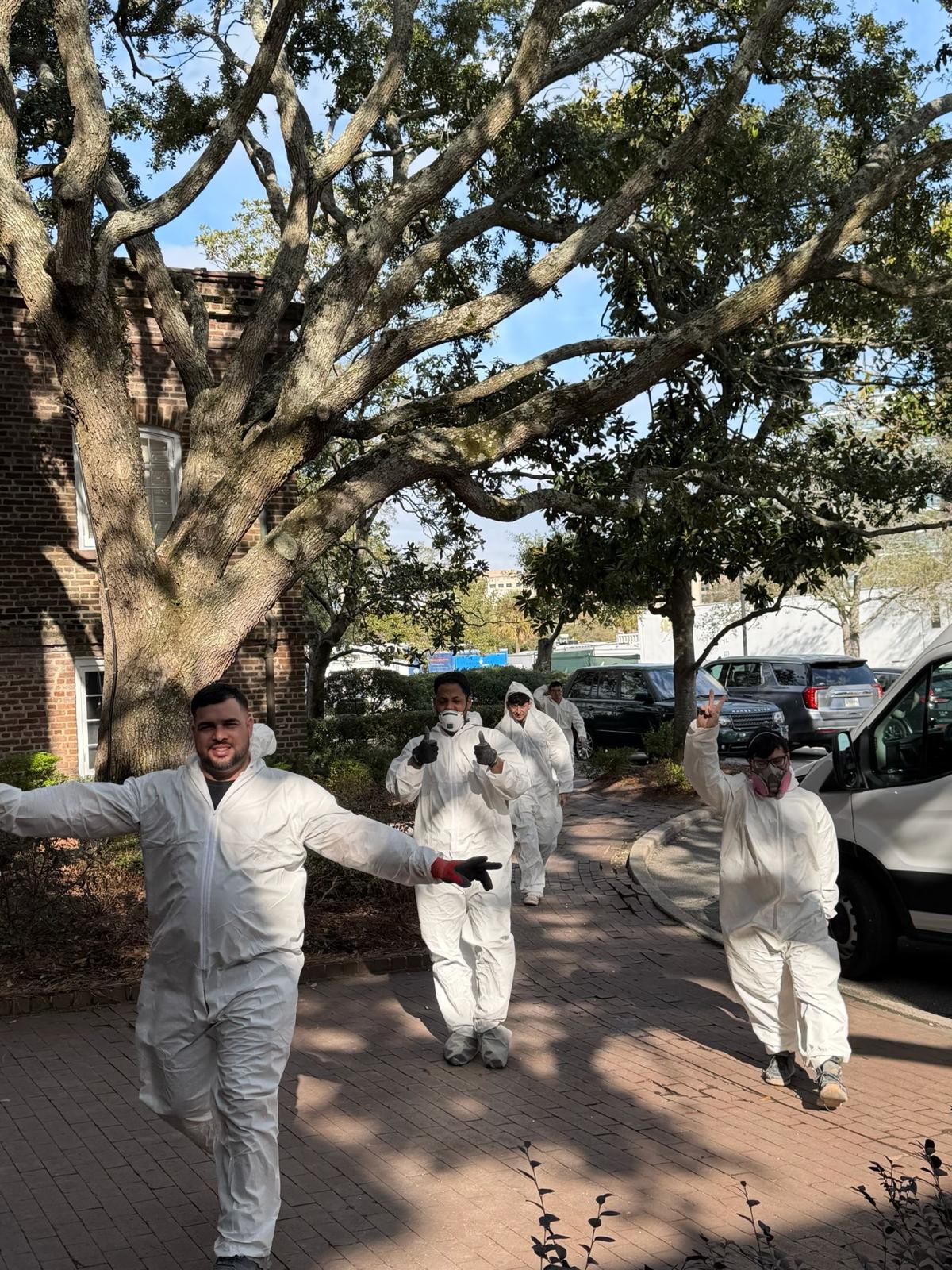
- We wear personal protective equipment so contaminated material gets handled safely, not spread further
When We Tell Customers to Skip Us and Handle It Themselves
We'd rather be straight with you than sell you a job you don't need. For a small patch on a non-porous surface, we tell customers to handle it themselves. The EPA generally considers a moldy area under about 3 feet by 3 feet on a hard surface safe to clean with gloves, a mask, and a bleach or detergent solution.
Past that size, or once mold reaches a porous or hidden area, we'll tell you to bring us in. We won't recommend bleach for anything beyond that small scope, since it doesn't reach mold roots growing inside drywall, wood, or insulation, and scrubbing it can release more spores into the air rather than fewer.
What We Don't Do
We'd rather set the right expectations up front than overpromise. We don't handle full structural rebuilds on our own. If framing or subfloor needs replacing, we coordinate that with a general contractor or hand it off as a follow-up project rather than bundling it into remediation.
We're also not the ones to ask for legal advice on mold disclosure requirements in a real estate transaction. What we do instead is document the problem, the cause, and the fix clearly enough that you or your agent can hand it to whoever needs it.
If the mold started with a leak or a burst pipe, we usually treat remediation and drying as two separate steps. Our water damage restoration in Raleigh team often handles the water side of a job before we start remediation.
The Certifications We Hold and Why We Got Them
North Carolina doesn't issue a state-specific mold remediation license, so we lean on third-party certifications to prove our team knows what it's doing. We're IICRC certified for containment, removal, and remediation protocols. We're NADCA certified for ventilation system mold work. We're NORMI certified as mold remediation specialists.
Here's what we make sure you get on every job, and what we'd tell you to demand from anyone else you're considering:
- Certified, insured technicians on-site, not subcontractors we haven't trained
- A full written scope of work, testing included, before we touch anything
- A plan that addresses the moisture source, not just the mold you can see
- Post-remediation clearance testing built into the price, not an upsell
Why We Think Professional Mold Removal Is Worth It
For anything beyond a small, easily accessible spot, we think it is. A standard residential job with us typically runs a few hundred to a few thousand dollars, and what that buys you is documentation, a fixed moisture source, and a much lower chance of paying us or anyone else to solve the same problem twice.
We see that value show up most in two situations. If you're selling a home, we've found that a documented, professionally remediated mold problem reassures buyers and their inspectors in a way a DIY cleanup never fully does. If you're filing an insurance claim, we can pair our work with indoor air quality testing so your adjuster has something concrete to evaluate instead of your word against a stain.
Frequently Asked Questions
Does mold need to be removed professionally, or can I do it myself?
We'll tell you to handle it yourself if it's a spot under about 3 feet by 3 feet on a hard surface. Anything larger, hidden, or affecting an HVAC system, we'd recommend bringing us in.
What's the difference between mold removal and mold remediation?
Removal is what we'd call cleaning up the visible mold. Remediation is what we actually do, removing the mold and fixing the moisture problem that caused it, which is the part that keeps it from coming back.
What do you do that a regular cleaning service can't?
We contain the area so spores don't spread, remove materials that can't just be wiped clean, trace and fix the underlying moisture source, and document the entire process. A cleaning service typically only wipes down what's visible.
Do you guarantee your work?
We do. We back every project with a guarantee on the remediation performed at the time of service, and customers on our annual maintenance plan get a 3-year mold-recurrence warranty on top of that.
Will you also fix the leak or water damage that caused the mold?
Often, yes, though we may bill it as a separate step. We sometimes bring in our own water damage restoration team or coordinate with an outside plumber depending on the scope.
Is professional mold removal worth the cost?
We think so, for anything past a small surface spot. What you're paying for is documentation, proper containment, and a fixed moisture source, all of which lower the odds you're paying us or anyone else to solve the same problem again next year.