

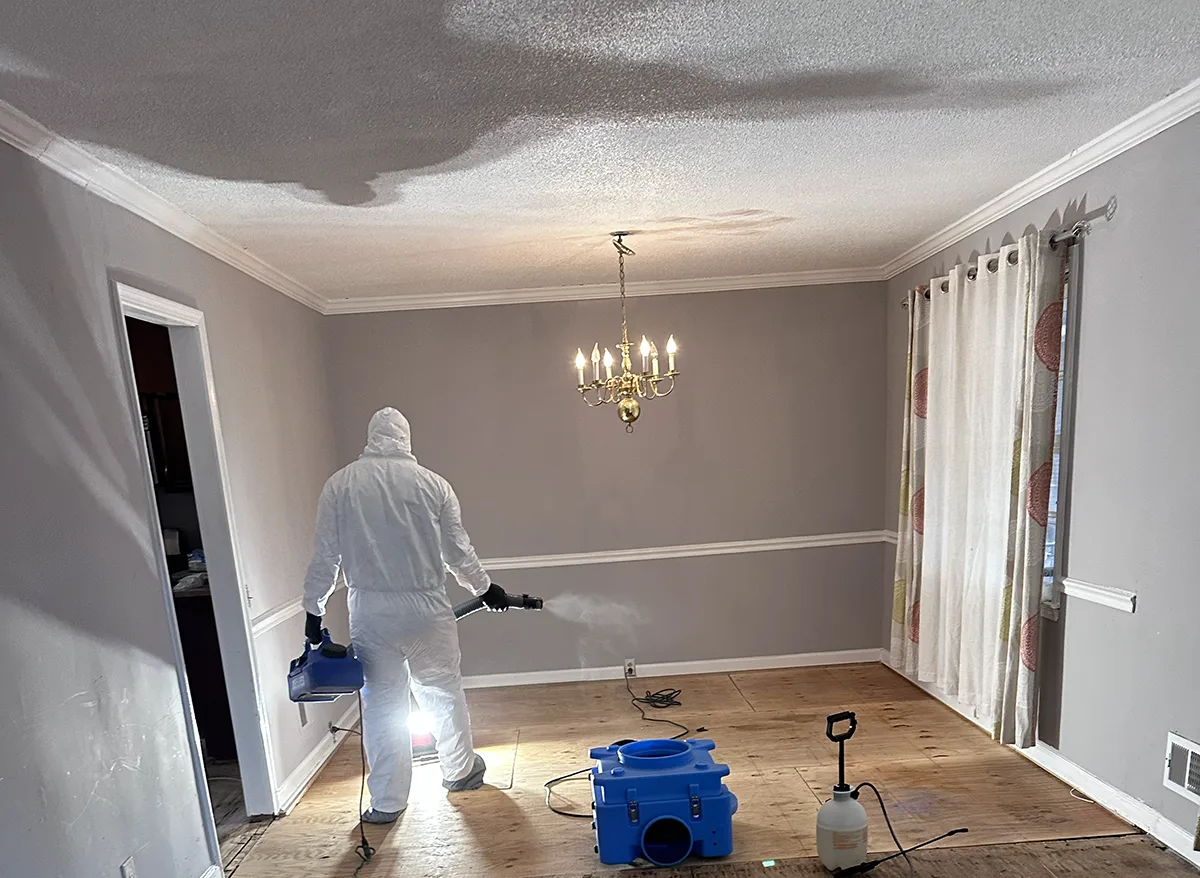
Mold in a crawl space almost always comes down to one thing: humidity above 60 percent for long enough that spores take hold, usually from a vented crawl space pulling in Raleigh's humid outdoor air. Why does your crawl space smell musty before you ever see visible mold? Because that earthy smell is the mold itself, releasing gases as it grows, not just a dirty, closed-up odor you can cover with an air freshener.
Our IICRC-certified team has handled mold remediation in Raleigh crawl spaces for 15 years, and we see the same pattern on almost every call: a vented crawl space, Triangle humidity, and clay soil that won't let moisture drain. Below are the specific causes we find, the humidity numbers that decide whether mold actually grows, and what it takes to fix it for good.
1. High Humidity and Condensation
This is the leading cause in the Triangle, and it doesn't require a single leak to happen. In July 2025, Raleigh recorded an average dew point of 69.8°F, the highest of any July since 1946 according to the NC State Climate Office, and outdoor relative humidity regularly runs 70 to 90 percent from May through September. When that warm, humid air flows through open foundation vents and meets cooler surfaces underneath your home, concrete block, ductwork, wood framing, it condenses on contact. Vented crawl spaces were built on the assumption that outdoor airflow dries out the space. In North Carolina's climate, that assumption works against you for most of the year.
2. Standing Water or Groundwater Seepage
Wake County's clay-heavy soil doesn't drain, it holds water. A single inch of rain can keep the ground saturated for 10 to 14 days, and that moisture pushes upward into the crawl space the entire time. Cracks in the foundation wall, poor grading, and downspouts that dump water right next to the house all add to this. Standing water is also the fastest path to serious mold and wood rot, since it keeps humidity at saturation instead of just elevated.
3. A Dirt Floor With No Vapor Barrier
Bare soil releases moisture continuously, rain or shine. Much of Raleigh's older housing stock has a dirt-floor crawl space with no covering at all, which means the space is being humidified from below every single day, independent of what's happening outside. A missing or torn vapor barrier is one of the most common findings on our inspections.
4. Leaky or Uninsulated Ductwork in the Crawl Space
Ductwork that runs through the crawl space, common in Raleigh homes, creates cold surfaces the moment the AC kicks on. Humid crawl space air condenses directly on that cold metal, and leaking supply ducts make it worse by dumping conditioned air into the space instead of your living area. This is also why crawl space moisture problems often show up first in spring, as soon as the AC starts running for the season.
5. Organic Debris and Wood Touching the Soil
Construction scrap, cardboard, fallen insulation, and old stored boxes are all mold food once humidity is high enough. Wood that sits in direct contact with the soil wicks moisture upward and starts rotting from the bottom, often before anything looks wrong from above.
6. Plumbing Leaks or AC Condensate Lines
A slow drip from a supply line, or a condensate line that terminates under the house instead of draining away from it, keeps a small area permanently wet. These are easy to miss because the affected spot is often small and out of sight. If a leak like this caused water damage before mold set in, our water damage restoration team handles the drying and repair side separately from remediation.
Is That Smell Definitely Mold?
Not every crawl space odor means mold. Sorting the smell first saves a lot of guessing.
If the smell is showing up somewhere other than the crawl space, it's worth ruling that room out too. We've covered a related but separate set of causes in why does my bathroom smell musty.
The Humidity Numbers That Decide Whether Mold Grows
Guessing wastes time. These are the numbers that actually matter.
Relative humidity above 60 percent, sustained for a few weeks, is enough for mold to establish on wood framing. For a properly controlled crawl space, we target 45 to 55 percent relative humidity, which is low enough to stop mold without over-drying the wood. Wood moisture content matters more than air humidity, since mold responds to how wet the wood actually is. Above roughly 16 to 20 percent moisture content, wood supports mold growth regardless of what the air feels like.
The cheapest way to check where you stand is a basic hygrometer, around $15 to $30 at any hardware store. Leave it in the crawl space for a few days and check it during a humid afternoon rather than a dry morning. A reading above 60 percent means the space is already in the range where mold can take hold.
What to Do About Crawl Space Mold
The order matters here. Skip a step and the smell, or the mold, comes back.
Stop the water first. Fix grading, extend downspouts away from the foundation, repair any foundation cracks, and address plumbing or condensate leaks. Nothing else holds up until the water source is gone.
Cover the ground. A vapor barrier cuts off soil moisture at the source. Full encapsulation goes further, sealing the floor, walls, and vents so humid outdoor air can't get in at all. We've broken down what this typically costs in our mold removal cost guide, since pricing depends heavily on crawl space size and condition.
Control the humidity that remains. Even a sealed crawl space needs a dehumidifier sized for the space to hold that 45 to 55 percent target through the humid months.
Remove what's already damaged. Wet insulation, moldy cardboard, and rotted wood all need to come out, not just get treated in place. Dead mold is still allergenic, so removal matters even after the mold is no longer active. For established mold, this is remediation work, not a cleaning job, and it typically takes a few days to a week or more depending on how far it's spread.
What Doesn't Work
A few common instincts actually make the problem worse.
- Bleach on crawl space wood. It doesn't penetrate porous wood, and it adds more water to a space that already has a moisture problem.
- Opening the vents in summer. NC building code (Section R409) allows crawl space vents to stay closed for exactly this reason, since Raleigh's summer dew points routinely exceed what's inside the crawl space. Opening vents in July adds moisture, it doesn't remove it.
- Air fresheners and odor absorbers. These mask the smell for a few days while the wood underneath keeps getting wetter.
- Skipping straight to mold testing. If you can smell it, that's usually enough of a finding on its own. Measuring moisture and finding the source tells you more than a lab test does.
When to Call a Professional
Some of this is reasonable homeowner work: checking humidity, clearing debris, extending downspouts, and sealing an obvious gap. Call a professional when you run into any of the following:
- Standing water under the house, or water that returns after every rain
- Visible mold across more than about 10 square feet of framing or subfloor
- A sewage smell or a broken waste line
- Rodent droppings, urine odor, or nesting material
- Soft, spongy, or crumbling wood, or floors that flex above the crawl space
- Crawl space humidity that stays above 60 percent even after you've addressed the obvious sources
Because the space beneath your home shares air with everything above it through the stack effect, a musty crawl space rarely stays contained to just the crawl space. If you want to confirm whether that air is already affecting your living space, indoor air quality testing can measure it directly.
Frequently Asked Questions
What causes mold in a crawl space?
Humidity above 60 percent sustained over time, usually from a vented crawl space pulling in humid outdoor air, standing water, a missing vapor barrier, or leaking ductwork. Most Raleigh crawl spaces have more than one of these at once.
Why does my crawl space smell musty if I don't see any mold?
The musty smell is caused by gases mold releases as it grows, which means you can often smell it before it's visible. A strong earthy odor is usually a reliable sign that mold is active somewhere in the space, even without a visible spot yet.
Can mold in a crawl space make you sick?
It can trigger allergy and asthma symptoms, coughing, congestion, and headaches, particularly in people with respiratory sensitivities. Because air moves from the crawl space into the rest of the house, exposure isn't limited to people who go under the home.
Should crawl space vents be open or closed in summer in Raleigh?
Closed, as part of a full system. NC building code allows sealed, unvented crawl spaces specifically because open vents pull in more humidity than they remove during a Triangle summer. Sealing vents alone without a vapor barrier and dehumidifier just traps moisture instead, so it needs to be done as a complete system.
How long does the musty smell take to go away after remediation?
Usually a few days to a couple of weeks, depending on how much damaged material had to be removed and how quickly humidity comes down afterward. If the smell is still there after a month, something is still wet or something moldy is still in place.
Schedule a Crawl Space Mold Inspection in Raleigh, NC
If your crawl space smells musty, the fastest way to find out what's actually happening is a mold inspection in Raleigh with moisture meters and infrared cameras, not another lab test. Our IICRC-certified team has completed more than 2,000 projects across the Triangle over 15 years. Call (919) 637-7839 or contact us for a free consultation.