

You walk in the door after a weekend away and something smells off. Damp. Earthy. A little like the back of an old closet. You open a window, light a candle, and by evening you have mostly stopped noticing it. Then the AC kicks on the next morning and it's back.
A musty smell in the house is one of those problems people put off, partly because it's hard to point at. There's no puddle, no stain, nothing obviously broken. But the smell is information. It's telling you that something in your home has been wet longer than it should have been.
Here's what causes it, what you can fix yourself, and how to tell when it's gone past the DIY stage.
What a Musty Smell Actually Is
The odor doesn't come from mold itself. Mold has almost no smell.
What you're smelling are microbial volatile organic compounds, or mVOCs. As mold and mildew break down damp materials like drywall paper, wood, cardboard, carpet backing, and insulation, they release these gases. Your nose picks them up at very low concentrations, which is why you can smell a problem well before you can see one.
That's the useful part. A mold smell in the house is usually an early warning, not a late one. Most people we talk to say the same thing: they smelled it first and found it later.
Is a Musty Smell Always Mold?
No. But it almost always means moisture, and moisture is what mold needs.
So the honest answer to "does musty smell mean mold" is this: sometimes it's mold you can't see yet, and sometimes it's a damp condition that will become mold if nothing changes.
Things that smell musty without active mold growth:
- Stagnant air. A closed guest room, a vacation house, a closet nobody opens. Air sits, humidity climbs, fabrics absorb it.
- A dirty or wet HVAC system. Condensation on the evaporator coil and standing water in the drain pan smell musty on their own. The catch is that these are also two of the most common places mold actually grows.
- Old carpet and pad. Carpet padding holds moisture for a long time and holds odor even longer, sometimes years after the spill that caused it.
- Damp laundry. Towels left in the washer overnight, gym clothes in a closed hamper, a front-loader with a mildewed door gasket.
- A dry P-trap. A floor drain or guest bathroom that never gets used lets sewer gas back into the room. That one smells different, more sulfurous than earthy, but people often lump it in.
- Dead animal in a wall or crawl space. Unpleasant and distinct, but easy to confuse with mustiness in the first day or two.
Things that mean you likely do have mold:
- The smell keeps coming back after cleaning and airing out.
- It gets stronger when the heat or air conditioning starts.
- It's concentrated in one area: a closet wall, under a sink, near the crawl space hatch, along a baseboard.
- There's a known history of a leak, a roof issue, or standing water in that spot.
- Somebody in the house has allergy or breathing symptoms that ease up when they leave.
If two or more of those apply, guessing isn't a great use of your time. A mold inspection uses moisture meters and infrared cameras to find damp material behind surfaces without opening walls, and lab samples tell you whether your indoor spore levels are actually above the outdoor baseline.
What Are the First Signs of Mold in a House?
The smell is usually first. After that, in rough order of how often people notice them:
1. A musty odor in one specific area. Not the whole house. One closet, one corner, one room, or a smell that hits you when you open the crawl space door.
2. Allergy symptoms that follow you home. Sneezing, congestion, headaches, itchy eyes, or a cough that improves at work and comes back at night. Mold isn't the only explanation, but the pattern is worth paying attention to.
3. Discoloration you'd probably dismiss. Not always black. Mold shows up gray, white, green, pink, or as a fuzzy dark ring around a window frame or on a bathroom ceiling. On paint it can look like a stain that won't wipe off.
4. Paint or wallpaper that isn't sitting flat. Bubbling, peeling, or a section of drywall that feels soft when you press it means water has been behind that surface long enough to matter.
5. Condensation where it shouldn't be. Water beading on windows, on ductwork, or on the toilet tank in summer means indoor humidity is high enough for mold to start on its own, no leak required.
6. Warped floors or trim. Cupped hardwood, a lifting seam in vinyl plank, baseboards pulling away from the wall.
7. Mold that comes back after you clean it. This is the big one. Surface cleaning a spot that returns in a few weeks means you cleaned the symptom and left the water source alone.
Worth saying plainly: mold needs about 24 to 48 hours of wet material to get started. It doesn't take a flood. A supply line dripping behind a dishwasher will do it.
Common Causes of a Musty Smell in the House
Go looking in this order. Most of the time it's on this list.
The crawl space. In the Triangle this is the number one spot. Warm, humid outdoor air enters a vented crawl space, hits cooler surfaces underneath the floor, and condenses on joists, subfloor, and the paper facing on batt insulation. The smell then rides up through floor penetrations into the house.
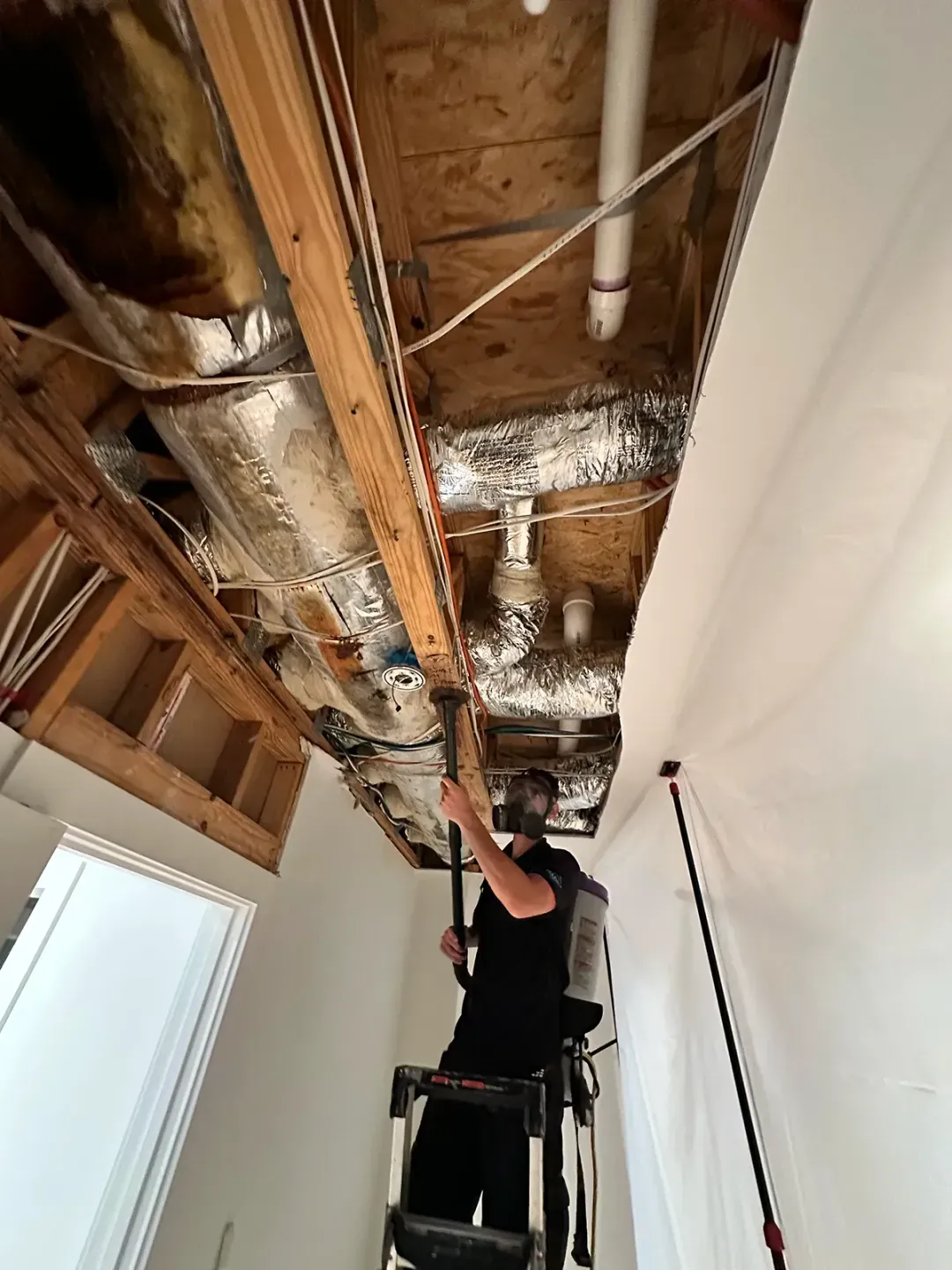
The HVAC system. Air handler, evaporator coil, drain pan, and the first few feet of duct. If the musty smell shows up within a minute of the system starting and comes out of multiple vents, that's your answer. Mold in the ductwork spreads the odor to rooms with no moisture problem at all, which is why the smell can seem to come from nowhere.
Bathrooms. Exhaust fans that vent into the attic instead of outside, or fans that are undersized, or nobody runs them. Grout, caulk, and the wall behind a tub surround take the damage.
Under sinks and behind appliances. Slow supply line drips, failing dishwasher gaskets, refrigerator ice maker lines, washing machine hoses. These leak into a cabinet base or subfloor for months without visible water.
Basements and lower levels. Below-grade walls, poor exterior grading, downspouts dumping water at the foundation.
Attics. Old roof leaks, bath fans venting into the attic, and inadequate ventilation. The smell tends to show up in upstairs hallways or near the attic access.
Windows and exterior walls. Failed flashing, failed window seals, or a spot on the north side of the house that never dries out.
Soft goods. Rugs, upholstered furniture, curtains, stored boxes, and clothes in a damp closet. These don't usually start the problem, but once the house has been musty for a while they hold the odor and keep reintroducing it after you've fixed the source.
Why Musty Smells Are Common in Raleigh Homes
Raleigh gets roughly 46 inches of rain a year, well above the national average of about 38. Summer dew points regularly sit above 65 degrees, which is the point where outdoor air stops being able to dry anything out and starts adding moisture instead. Humidity stays high through most of spring, summer, and early fall.
Add the local housing stock. A large share of homes across Raleigh, Cary, Durham, and Chapel Hill sit on vented crawl spaces. In July, pulling 75-degree outdoor air with a 72-degree dew point into a crawl space where the subfloor is sitting at 68 degrees means condensation. It's physics, not neglect. Plenty of well-maintained homes have wet crawl spaces for exactly this reason.
Newer construction has the opposite problem. Tight, well-sealed envelopes hold moisture in. Without decent ventilation and a properly sized HVAC system that actually runs long enough to dehumidify, indoor humidity creeps up and stays up.
Then there's storm season. Heavy summer thunderstorms and the occasional tropical system push water into places that stay dry the rest of the year: crawl spaces, basements, wall cavities behind failed flashing. A lot of the musty smells we get called about in September trace back to a storm in July.
Natural Fixes That Actually Work
These help, and some of them will solve a mild problem outright. None of them will fix a leak.
Get the humidity down first. Everything else is secondary. Aim for 30 to 50 percent indoor relative humidity, and never let it sit above 60. A $15 hygrometer from a hardware store tells you where you stand. If you're above 60 in the summer, a dehumidifier in the problem area will do more than any other single thing on this list.
Run your bathroom fan longer than you think. Fifteen to twenty minutes after the shower ends, not thirty seconds. Confirm it actually vents outside, not into the attic, which is a genuinely common mistake in Triangle homes.
Cross-ventilate on the right days. Opening windows helps in October. It hurts in August, when you're inviting humid air in. Check the dew point, not the temperature.
White vinegar on hard surfaces. Undiluted, sprayed on, left for an hour, then wiped. Vinegar handles surface mildew on tile, grout, and non-porous surfaces better than most people expect. It won't reach anything growing inside drywall or wood.
Baking soda for soft goods. Sprinkle on carpet, rugs, and upholstery, leave it a few hours or overnight, vacuum thoroughly with a HEPA vacuum if you have one. Repeat if the smell is stubborn.
Activated charcoal or bowls of baking soda in closed spaces. Closets, cabinets, under sinks. These absorb odor rather than covering it, which is the difference between them and an air freshener.
Deal with the soft goods properly. Wash curtains, blankets, and pillow covers. Steam clean or professionally clean carpets and upholstery. In a house that's been musty for a long time, fabrics become a second source and will re-seed the smell even after you fix the actual moisture.
Move the air. Ceiling fans, a box fan in a stagnant room, closet doors left cracked open. Still air holds moisture against surfaces.
What to skip
Candles, plug-ins, and air fresheners. They mask the smell for a few hours while whatever's causing it keeps growing.
Bleach on porous surfaces. Bleach is mostly water. On drywall or wood it kills what's on the surface, leaves the roots, and adds moisture to the material. It also aerosolizes spores while you scrub. It has its uses on tile and glass. Drywall isn't one of them.
Ozone generators. Ozone is a lung irritant and unsafe to breathe. It also doesn't remove mold, only the odor, temporarily. If you've read about them online, treat them as a last resort handled by someone who knows the safety requirements, not a weekend project.
When to Stop and Call Someone
Call for help when any of these are true:
- The affected area is bigger than about 10 square feet.
- You can smell it clearly but can't find it.
- It came back after you cleaned it.
- There's been a leak, a burst pipe, or standing water in the last few months.
- The smell is coming out of your vents.
- Anyone in the house has asthma, a compromised immune system, or symptoms that keep getting worse indoors.
- You're buying or selling and need documentation, not a guess.
Two different situations, two different starting points. If the source is unknown, start with indoor air quality testing or a mold inspection so you know what you're dealing with before anyone opens a wall. If you already know there's water, whether from a pipe, a roof, or a storm, water damage restoration needs to happen fast, because the 24 to 48 hour window is real.
When testing confirms a real problem, mold remediation in Raleigh means containing the area, removing affected material, treating what's left, and correcting the moisture source. That last part is what determines whether you're doing this again next summer. If you want to know what to expect, we've written up how long mold remediation usually takes, what mold removal costs in Raleigh, and whether homeowners insurance covers mold in North Carolina.
How to Prevent Mold in Your Home in Raleigh
Prevention here is mostly about humidity control, which in this climate means being a little more deliberate than homeowners in drier parts of the country need to be.
Keep indoor humidity between 30 and 50 percent year round. Buy a hygrometer. Check it in the rooms you worry about, not just the hallway.
Handle the crawl space. A properly installed vapor barrier over the soil is the minimum. Encapsulation with a dedicated dehumidifier is the real fix, and in Raleigh it's usually money well spent. Check it once a year for standing water, torn plastic, and sagging or fallen insulation.
Service the HVAC system twice a year. Have the drain pan and line cleared and the coil inspected. A clogged condensate line backs water up into the air handler, which is one of the fastest routes to a whole-house mold smell.
Change filters on schedule. Every one to three months depending on the filter. Longer than that and you're restricting airflow, which encourages condensation on the coil.
Vent bathrooms and the kitchen to the outside. Confirm it. Go into the attic and look at where the duct terminates.
Fix leaks the week you find them, not the month. A slow drip under a sink costs almost nothing to repair and thousands to remediate once it reaches the subfloor.
Manage water outside the house. Clean gutters twice a year, extend downspouts at least four to six feet from the foundation, and make sure the ground slopes away from the house. A surprising amount of interior moisture starts with a downspout dumping at the corner of a crawl space vent.
Dry anything wet within 24 to 48 hours. Spills, overflows, and pipe drips. This single habit prevents more mold problems than anything else on the list.
Don't over-seal. If you tighten up a house without adding ventilation or dehumidification, humidity has nowhere to go.
Frequently Asked Questions
Does a musty smell always mean mold?
Not always, but it always means moisture. A musty smell can come from stagnant air, damp carpet, a dirty HVAC system, or wet laundry with no active mold growth. If the smell keeps returning after cleaning, gets stronger when the HVAC runs, or follows a past leak, mold is likely growing somewhere you can't see.
What does mold smell like in a house?
Most people describe it as damp, earthy, or like wet cardboard, old books, or a basement. Some molds smell closer to sweat or stale smoke. The odor comes from microbial volatile organic compounds released as mold breaks down damp material, not from the mold itself.
Can a musty smell make you sick?
The odor itself isn't harmful, but what causes it can be. Mold spores and damp indoor conditions are linked to congestion, coughing, wheezing, headaches, and skin irritation, and cause more serious problems for people with asthma, allergies, or weakened immune systems. Masking the smell doesn't reduce exposure.
How do I find where a musty smell is coming from?
Work room by room and get low, since odor tends to be strongest near the source. Open cabinets under sinks, check the closet floors, stand under an HVAC vent right after the system starts, and open the crawl space or basement door and compare. If the smell is strongest at a vent, the problem is likely in the HVAC system rather than that room.
Why does my house smell musty only when the AC is on?
That usually points to moisture in the HVAC system: a dirty evaporator coil, standing water in the drain pan, a clogged condensate line, or mold in the first section of duct. The system pushes the odor through every vent, which makes it feel like the whole house is affected.
How do I get rid of a musty smell in the house naturally?
Lower indoor humidity below 50 percent with a dehumidifier, improve airflow, clean hard surfaces with white vinegar, use baking soda or activated charcoal to absorb odor in closed spaces, and wash or steam clean fabrics that have absorbed the smell. These work on mild cases. If the smell returns, there's a moisture source still feeding it.
Should I test for mold or just clean it?
If it's a small patch on a hard surface with a clear cause, cleaning is reasonable. Test when you can smell mold but can't find it, when it keeps coming back, when the area is larger than about 10 square feet, or when you need documented results for a sale, a landlord, or an insurance claim.
Get an Answer, Not a Guess
If your house smells musty and you can't find the source, that's exactly the situation an inspection is built for. Summit has spent 15+ years tracing mold and the water behind it across Raleigh and the Triangle. We find the moisture source, use independent lab testing, and hand you a written report in plain language.
Call +1 (919) 637-7839 or book a free consultation. Callbacks usually within 30 minutes.