
DIY mold test kits can tell you that mold spores are present. That's about it. They can't identify the type of mold, how much is in your air, or where it's actually growing. Professional mold testing covers all three, plus the moisture source feeding it.
Our mold inspection team at Summit gets asked about home test kits often, usually from someone who already bought one and wasn't sure what the results meant. Here's the quick comparison, followed by what each option actually involves.
DIY vs. Professional Mold Testing: Quick Comparison
What a DIY Mold Test Kit Actually Tells You
A DIY kit can confirm that mold spores exist in your home. That part works. The problem is what that finding means, and most kits stop well short of a useful answer.
It Can't Tell You If the Level Is Actually a Problem
Mold spores exist naturally everywhere, indoors and outdoors. Finding some in your home doesn't automatically mean you have a mold problem. What actually matters is:
- The type of mold present
- The concentration of spores
- Whether indoor levels are elevated compared to normal outdoor background levels
- Where it's growing
- What's causing it
Most home kits can't answer any of those five questions.
The Testing Method Itself Is Inconsistent
Most kits use a settle plate. You leave a small collection dish open in a room for 24 to 48 hours and let airborne particles settle on it naturally, then often mail the sample to a lab for an added fee. Airborne mold levels shift throughout the day based on airflow, HVAC cycles, and how many people are moving through a room. A dish left out during a quiet afternoon gives different results than one left out while the dishwasher's running and doors are opening and closing. That inconsistency can produce a false positive one day and a false negative the next.
A Lab Result Still Needs Someone to Interpret It
Even when a lab identifies a specific mold species by name, the report usually won't explain whether that species is tied to water damage, whether the level found is elevated, or whether remediation is recommended. That takes someone who understands how mold behaves indoors, not just what grew on a swab.
It Can't Point You Anywhere
A kit can confirm spores are floating around the house, but it can't tell you whether they're coming from the wall cavity behind your shower, the ceiling above a bathroom, the space under your flooring, or an HVAC duct. Hidden mold commonly grows in exactly those spots. Without finding the source, it keeps spreading even after a test confirms it's there.
What Professional Mold Testing Includes
A professional inspection looks past whether mold exists. It figures out why it's there, exactly where, and whether it's affecting your indoor air.
The Inspection Itself
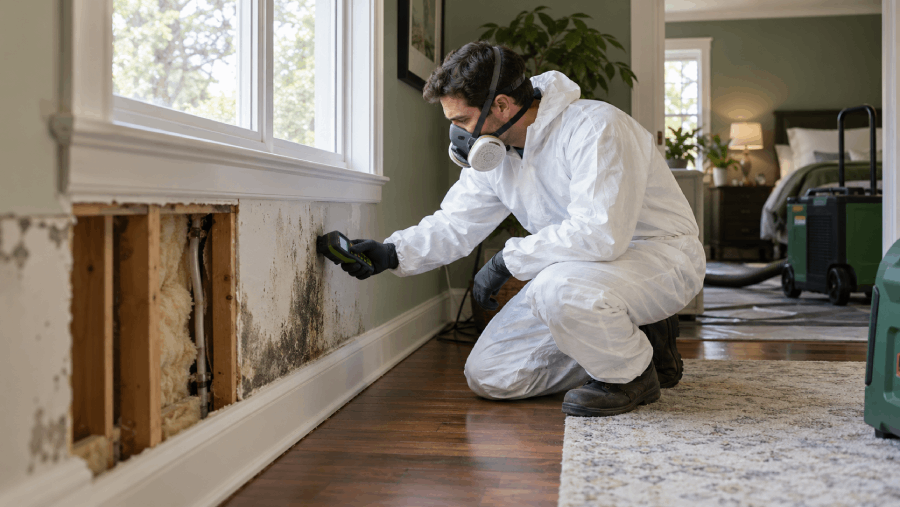
Ours typically includes a visual walkthrough, moisture mapping, infrared thermal imaging, moisture meter readings, and air or surface sampling sent to an accredited lab. A moisture meter and a thermal camera find damp areas and hidden leaks that no settle plate sitting on a kitchen counter will ever catch.
What You Get Afterward
A written report that explains what was found, where, and what it means, not just a species name with no context. If remediation is needed, that report lays out what has to happen next, instead of leaving you to figure it out on your own.
Which Option Should You Choose?
A DIY kit can satisfy curiosity if you're not seeing or smelling anything concerning. It can't tell you whether your home has a real mold problem or what to do about it.
Go with professional testing if you're dealing with visible mold, a musty odor with no obvious source, recent water damage or flooding, allergy-like symptoms at home, or any real concern about your indoor air quality. Those situations need answers a petri dish can't give you.
How Summit Approaches Mold Testing
We're IICRC-certified, licensed and insured, with more than 2,000 projects completed across the Triangle over 15-plus years. Every inspection starts with a full walkthrough and moisture mapping to find the source, not just confirm mold exists. If remediation is needed, we handle that too, with before-and-after documentation and clearance testing where it applies.
Schedule a Mold Inspection in Raleigh, NC
Skip the guesswork from a home kit. Call (919) 637-7839 or contact us to schedule a professional mold inspection and get answers you can actually act on.